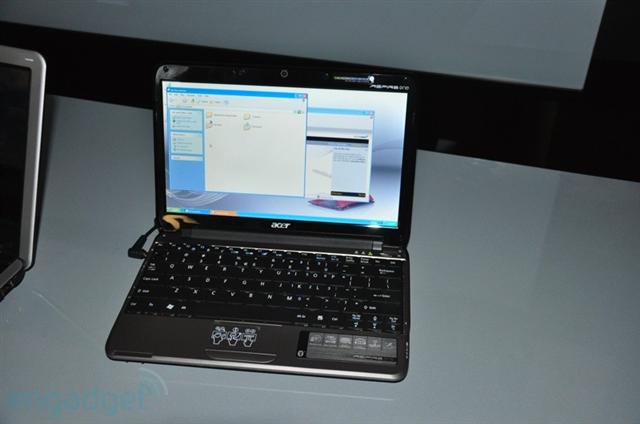
Engadget was able to take some exclusive pictures of the Acer 11-inch Aspire one. It looks quite huge to me in pictures, much wider than I expected it to be.
The US release date of the EEE 1008HA is now even more closer. How can we say that? The ultra thin 10-inch netbook from ASUS has been passed by FCC. So, it will be released in the US market any day now. Although I am a huge fan of thin netbooks/notebooks, I hate the fact that there is NO user replaceable battery in the 1008HA. It just does not make sense to send the netbook back to ASUS just to get the battery replaced.
Gigabyte T1028 TouchNote netbook made its first appearance at CeBIT 2009. Its product page is now finally online at Gigabyte’s web site. The T1028 is convertible netbook or shall we say tablet, which comes with 10.1-inch screen with backlight display. You can choose between two processors: Intel Atom N270 processor running at 1.6GHz or the newer N280 running at 1.66GHz processor. It comes with 1GB RAM, an integrated 3.5G module, Wi-fi and optional WiMAX.
The Gigabyte also lets you choose higher resolution: 1366 x 768 (instead of netbook-ish 1024 x 600).
Intel Atom processor is now 1 year old. On its birthday, Intel has introduced two new processor for the MIDs (Mobile Internet Devices). The next generation ARM platform known as Moorestone consumes 10 times less power as compared to the earlier Atom platforms.
Moorestown is comprised of a system on chip (Lincroft) that integrates a 45nm Intel Atom processor core, graphics, video and memory controller, and a companion I/O hub (Langwell).
Intel also annouced two processors which are going to soon debut in the netbook scene: Z550 and Z515. We mentioned about both of them few weeks back. Z515 is meant for low-powered MIDs. It will come with Intel Burst Performance Technology (Intel BPT), which will make the processor run at 1.2GHz when needed.
The Z550 is the first Atom processor to officially reach the 2.0GHz barrier. The Z550 consumes the same amount of power as the 1.86GHz Atom processor.
Lenovo is soon going to unveil 3G-version of the Lenovo S10. This will be known as Lenovo S10-2. A 12-inch screen model is also in the tunnel, which will be known as Lenovo S12. Both models will ship with Splashtop OS, which is basically a linux OS that can be booted in few seconds. It lets the user to browse the web; make Skype calls; use IM etc.
Intel has recently posted a webpage which lets the user decide between the netbooks and notebooks. By the article, it becomes very clear that the Intel is not happy the way the netbooks are affecting the sales of the notebooks. Couple of days we highlighted the fact, how the netbooks are affecting the sales of the notebooks.
click to see bigger image
From the chart given above (taken from this Microsoft link), it is clear that they perceive netbooks as devices for just surfing the web.
Multitask: According to MS, you cannot multi task on a netbook. Right now, I am multi tasking fairly nicely on my EEE 1000H with concurrently running Photoshop CS3, 2 Firefox Windows with each having 8 tabs and WMP 11 (running in the background playing my favorite tunes). No hiccups.
Create and Edit Videos: I use Windows Movie Maker all the time on my EEE 1000H and it works great for video editing on the go
Encode Music: I use Goldwave application to edit music and apply filters on the music and I do not face any particular slowdowns
Watch HD movies: 1080p with coreavc codec. ’nuff said
Play Games: Netbooks are able to play most of the games that came around 4-5 years ago. Netbooks were never meant to replace your PSP, Xbox etc anyway
Run Complex office software: Office 2007 works fine on my netbook without any slowdowns
I personally use my netbook for everything. Even for heavy duty tasks like audio editing and video editing, it works great. The Atom CPU provides more than enough power for my needs. I am not a gamer. Perhaps that is the reason, I do not yearn for the Core 2 Duo processor in my netbook.
I can fully understand that the netbooks are affecting the sales of the notebooks, but misguiding customers especially by a company like Intel was not expected.
We have heard several times(here and here) about the ASUS phasing out the 8.9-inch netbooks soon. Now, they have decided to keep them for the procurement market. But, reports do say that ASUS will eventually phase them out as they want to concentrate more on the 10-inch netbooks. The report also said that the company will also keep the 7-inch models for the telecom market.
I still do not completely agree with their decision of phasing out the 8.9-inch models. I love my EEE 1000H and other 10-inch netbooks that I have, but they are not as portable as EEE 900, whose size is quite similar to the EEE 700-series.
There is no doubt in the fact that the netbooks have become very popular among the consumers. In fact, it is so popular that almost every notebook manufacture has a netbook under its brand. That is why we completely agree with the statement by LeBlanc who is a Microsoft in-house blogger.
The growth of Windows on netbook PCs over the last year has been phenomenal
He further pointed out that those who bought linux netbooks returned them after sometime and bought themselves a netbook running Windows XP. Well, according to me it is due to the stubborn mindset of the people. They have all developed a notion that Linux is only for geeks. They do not want to spend few days learning the new OS.
On the brighter side, he confirmed that there will be a netbook version of Windows 7, which will be highly optimized.
Digitimes is reporting that HTC is planning to launch an Internet-enabled feature phone later this year. However, contrary to what we would think, this would not be running Windows Mobile (or Android). It would instead be running BREW MP. HTC will be bundling it with wide range of flash applications to provide multimedia services to the user.
Last year, HTC did give us all a hint that they will be launching an updated version of the HTC Advantage (X7510), but we did not know that it would not be running Windows Mobile.
For those who do not what BREW MP is: It is a mobile platform made by Qualcomm
There are two several ways to twit on a Windows Mobile:
The best way is to use a dedicated twitter application like Pocketwit which is a freeware. With it, you can post to Twitter using a URL you want to share, a picture you have stored on your smartphone, or a picture you just snapped with the camera, and you can even insert a GPS link showing your location.
HelloTwitFace: It gives you the ability to post your status on Twitter and Facebook or HelloTxt

 Atom Z530 + Intel SCH USW15S chipset


 Intel Atom processor is now 1 year old. On its birthday, Intel has introduced two new processor for the MIDs (Mobile Internet Devices). The next generation ARM platform known as Moorestone consumes 10 times less power as compared to the earlier Atom platforms.


 There are